

My approach to Higher Morality
As promised in my post on World Religion, this post will include my slides from my STARME talk that focus on the Morality Section and how I teach the exam technique for that section. I’ve already shared a bunch of examples for this section – so do take a look through my back posts – but this is more how I approach Teaching and Learning more than anything else.
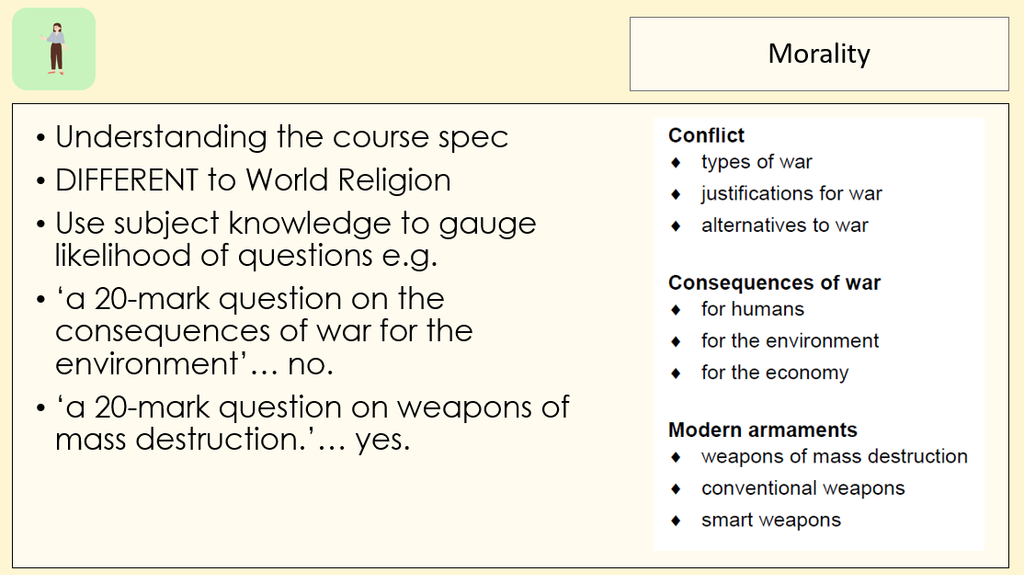
As with the World Religion, I start by sharing the Course Specification with my pupils. They MUST be familiar with this language and I quiz them repeatedly about what each of the subject headings include. This is important because if they were asked about ‘conflict’ and started writing about conventional weapons… this wouldn’t be credited as it’s not that part of the course. If we’re being honest, a pupil who hasn’t been explicitly taught that might fairly think that weapons are part of conflict… but this is why this is the list that I live and die by – and why I reiterate this time and time again in my course notes.
It’s also important to note that candidates do not need to know 10 knowledge and understanding points about every one of these headers. They really only need 1 or 2. The thing we’re actually interested in is ‘morality’ so I spend far more time talking through moral issues and applying different kinds of thinking to that.
The other question that often comes up is ‘could we have a 20-mark question focused on the consequences of war for the economy*?’
*Replace with any of the ‘smaller’ bullet points.
So, the answer is technically yes. But let’s use your common sense. These questions have to be fair to candidates and if you think a question would be horrifically difficult then it’s not really likely to be asked.
So I will prepare my candidates on a 20-mark question that focuses on WMDs, Capital Punishment, Gender Inequality and Discrimination in Society etc. (depending on what unit we’re studying!!) But I would not ask them to attempt one on deterrence, same-sex marriage, or environmental consequences of crime.
You will also notice that for the last three years… the QS have asked 20-mark questions about the ‘main headers’ and in my mind, this is a fair expectation of what’s ahead.
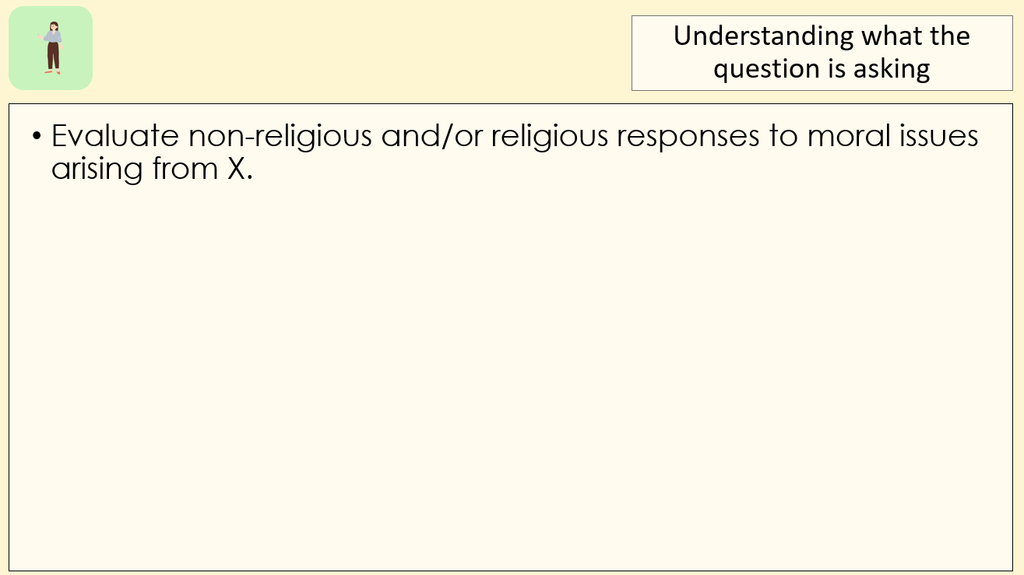
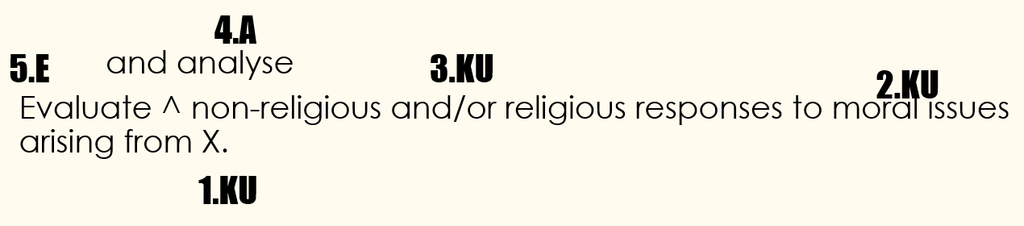
As with the 20-mark question in the World Religion, this question is actually worth 10KU marks, 5A, and 5E. But as the word ‘analysis’ doesn’t appear, candidates ‘can’ get marks for taking that analysis in a few directions. However, I think that this leads pupils in the wrong direction because we’re then asking them to analyse the response – and if they haven’t really explored/expanded on the response to the issue. Then they’ll end up evaluating the wrong thing. Which is why (as I’ve explained in many posts previously) I teach a very clear structure, working backwards through the question as follows…
Initially, I ‘ladder’ this structure even further by breaking it down into National 5 style questions:
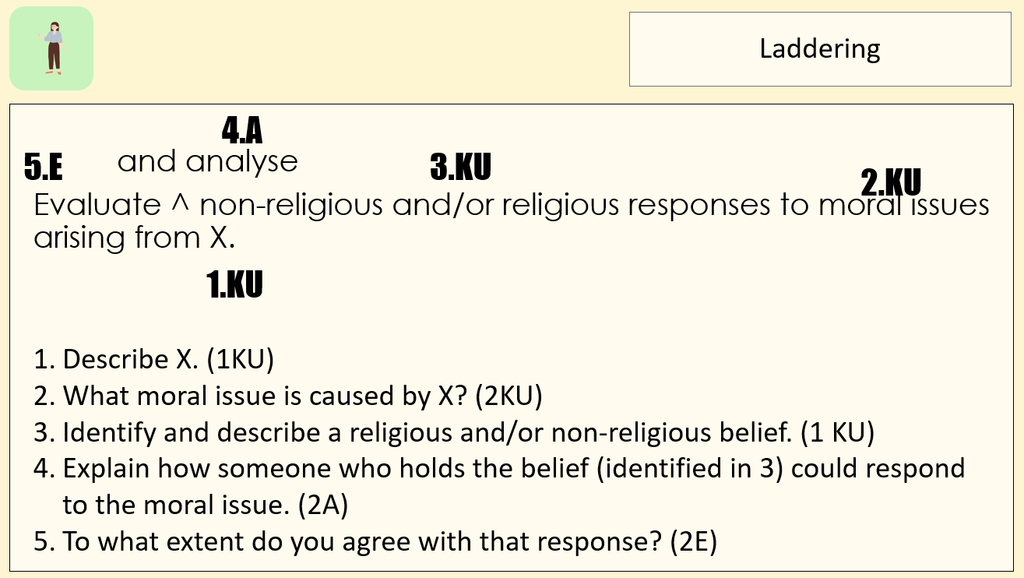
And here’s an example of that in action:
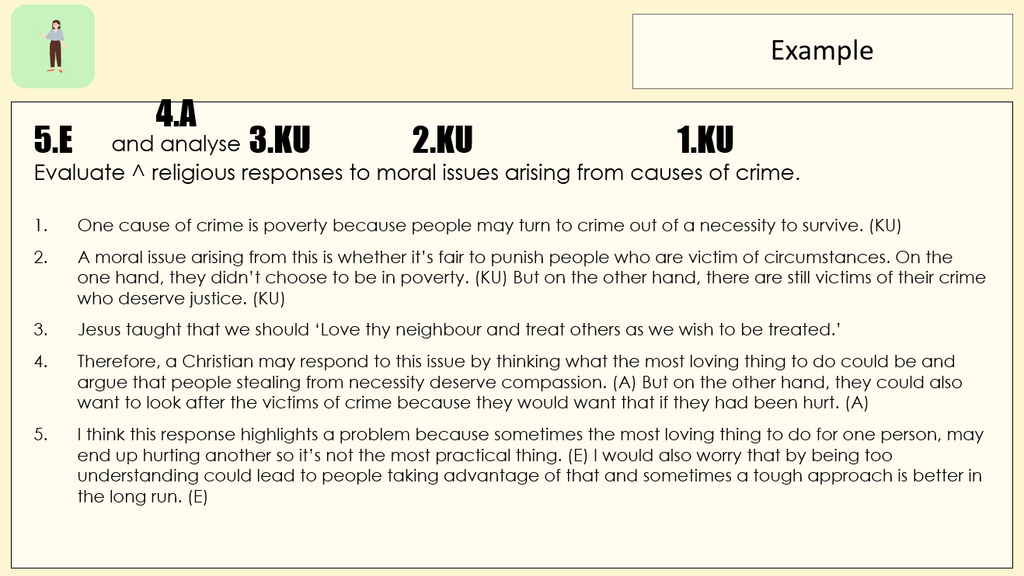
I know one of my colleagues (from a different school) felt like the ‘Churchill Dog’ at this point of my talk – but it was very comforting to have another experienced teacher nodding along! Particularly as Justice is her ‘thing’!
Someone asked why the explanation of the moral issue wasn’t given as analysis – so I said that it’s because the moral issue is factual. The candidates should be identifying an issue and this unpacking of it is really just showing understanding. It’s not strictly necessary to explore it in this depth, but I find that by doing so, it gives them a little more to analyse and evaluate later on.
Also, yes – they could spend time trying to analyse the quote – perhaps exploring other ways it could be applied… but if they took that approach in a 10-mark question then they wouldn’t pick up marks as they would not be analysing what they’ve been asked to. But by taking this approach, it is super easy to adapt to a 10-mark question (you just leave out the evaluation!)
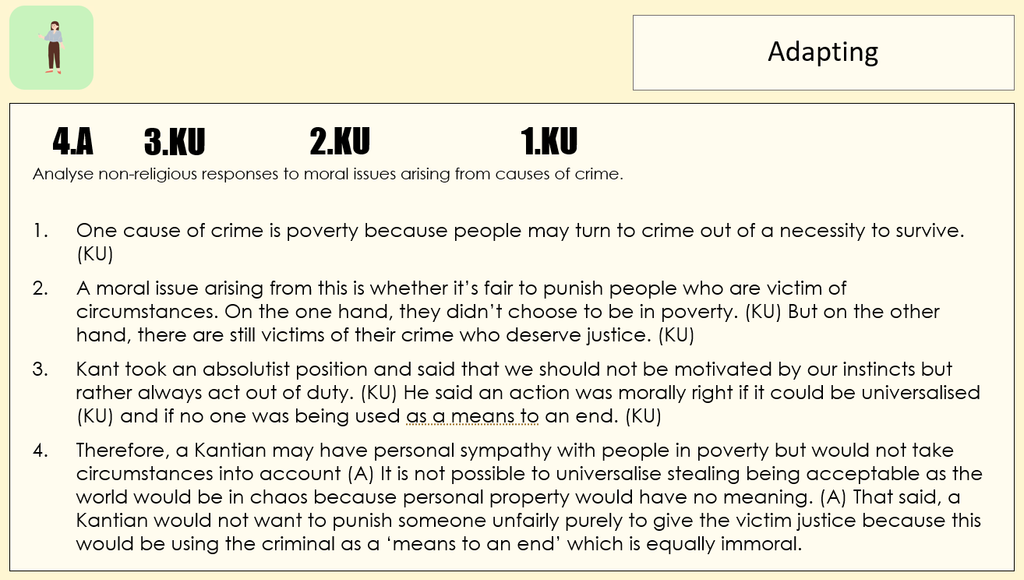
I can’t remember at what point I raised the idea of ‘responses’ but I also explained I do not teach set views for each and every topic. I know some centres like to look at the UN or Scottish Governmental papers… but I have two thoughts on that: 1) These often can only be used for one topic and add a lot to the overall content pupils need to learn and 2) I’m not a Modern Studies teacher – we’re theologians or philosophers – therefore I would MUCH rather teach moral theory and then allow pupils to develop analysis skills for themselves.
I’m not sure if there were other questions that I’ve missed out – but please do let me know in the comments below if there are any that you have! Or feel free to email.