

My approach to Higher World Religion
Recently, I was kindly invited by STARME to share my approach to teaching Exam Skills at Higher. Aware that not everyone who wanted to was able to attend, I thought I’d put together a post sharing my approach. I tend to overthink and tried to share as much as possible in the session – but will be breaking it down into four parts – my approach to teaching the different sections and then how I approach the Higher Assignment. Someone also asked how I teach the National 5 assignment – so I can put some thoughts together on that – if people would find it helpful?!
My approach to the World Religion
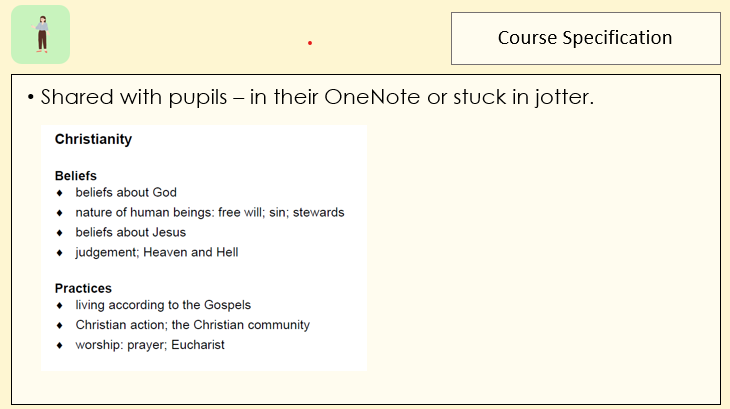
Regardless of which World Religion I’m teaching (I let my pupils vote), I always start by giving them the Course Specification for the section. This is the language that Qualifications Scotland will use to write questions, so it’s really important that pupils understand what is meant when they see terms like the ‘nature of human beings.’ This is even more key for religions with vocabulary that pupils might not be familiar with. For example, if a teacher simply taught ‘beliefs about the afterlife’ in Islam they would be teaching the content of the course – but if pupils were unfamiliar with the term ‘akhirah’ they would be completely sunk in the exam.
All of my course notes follow this exact structure for that reason – and I refer back to it repeatedly in my teaching.
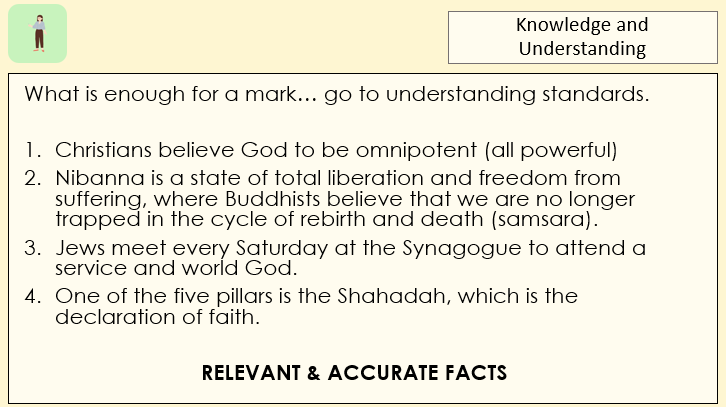
The next thing I do with my classes is to talk about the first skill – knowledge and understanding – or ‘KU’. Often, they think that I’m fibbing when I give examples of KU, so I show them understanding standards and explain that although these points may look simple – these candidates are actually doing a lot. They are not given this information in the question and have had to recall this in exam conditions. They’ve not just chucked in random bits of information, but have provided relevant and accurate facts.
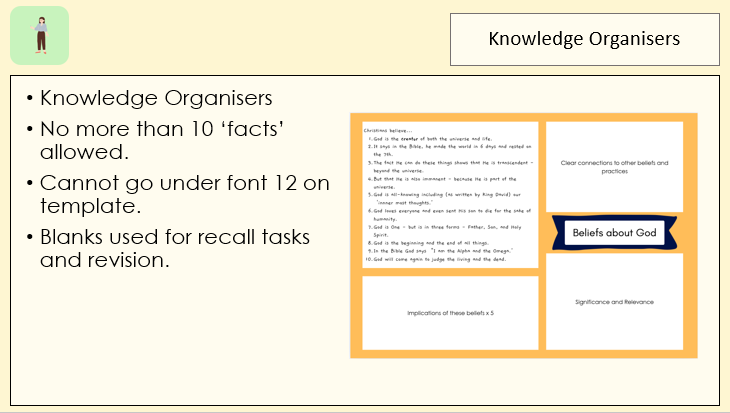
I have Knowledge Organisers for each of the mandatory headings – not tricky to make on Canva! – but as a rule of thumb, if they can’t fit 10KU points into the large box then they’ve not been concise enough and are going over the top.
I would also advise pointing students towards KU points that have more obvious implications or are really central. For example, whilst the Buddha may have had a wife named Yasodhara this little factoid doesn’t naturally lead to an obvious consequence.
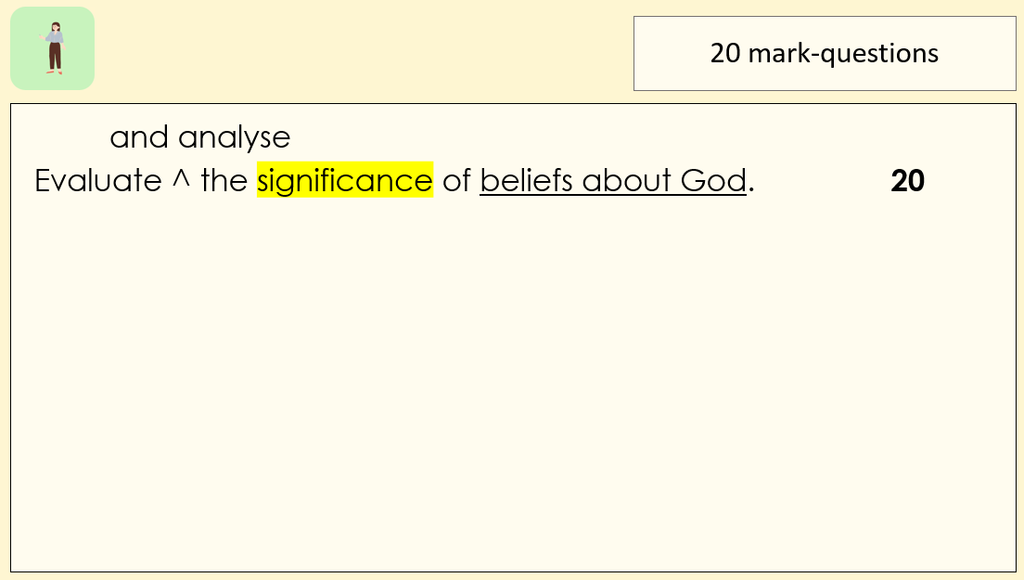
I do 20-mark questions first with my classes and begin by explaining a very deliberate form of editing. I want pupils to add in ^ and analyse in recognition there are 5 marks available for this skill. Then we underline the mandatory content term (the 10 KU) and then highlight the word that we need to evaluate for a further 5 marks.
Personally, I would like to see the skill breakdown communicated to pupils in the exam rather than just ’20’ – but hey, you don’t always get what you want in life!
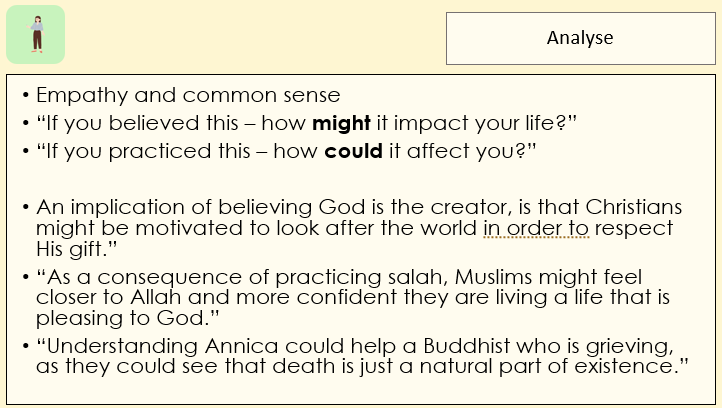
Often, my pupils believe they are analysing because the use the words ‘this means…’ but let’s take a look at this example:
“Christians believe that God is the creator this means that He made the world and everything in it.”
All that follows ‘this means’ is more knowledge! RMPS is unlike any other subject (in my view) because we have a huge opportunity to develop the skill of empathy. Analysis is identifying the possible consequences or implications – that gives us license to ask ‘If I believed this – what consequence would that have on the way that I feel, think, or behave.’ Through taking that approach, yes, I want pupils to link to other beliefs and practices… but not necessarily. I don’t teach explicit ‘analysis’ points and I really want them to really think for themselves.
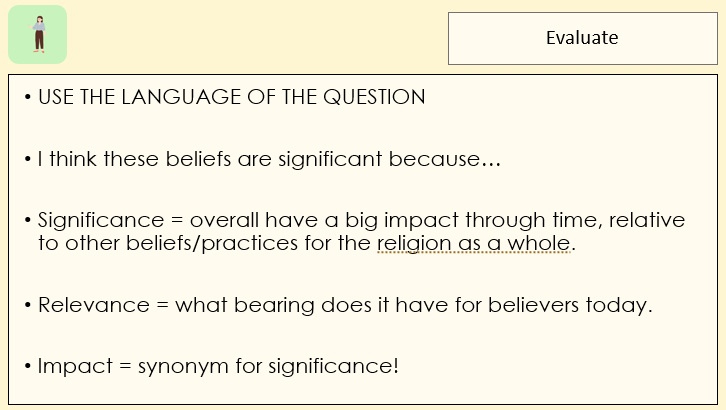
One could argue that significance, relevance, and impact are ALL synonymous. But I get my pupils to think of significance and relevance slightly differently.
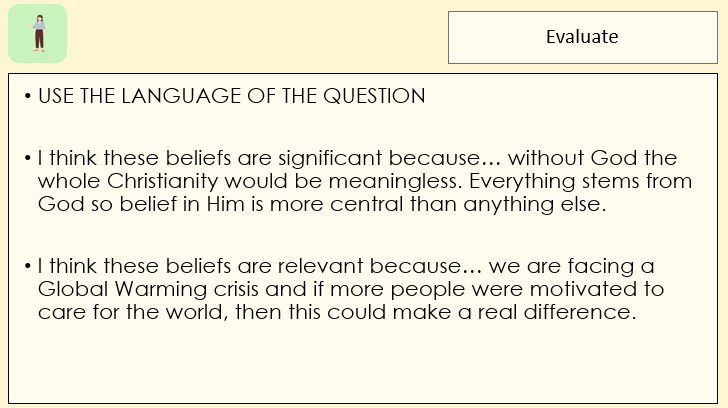
‘Relevance’ gives me an opportunity to look at what’s happening in the world and then ask the pupils whether this particular belief or practice could make a difference. It’s a sneaky way to bring in the news – but equally, a nice way to PROVE impact/significance/relevance etc.
Regardless of comment – the best advice is use the language of the question as a sentence starter…
Analysis questions
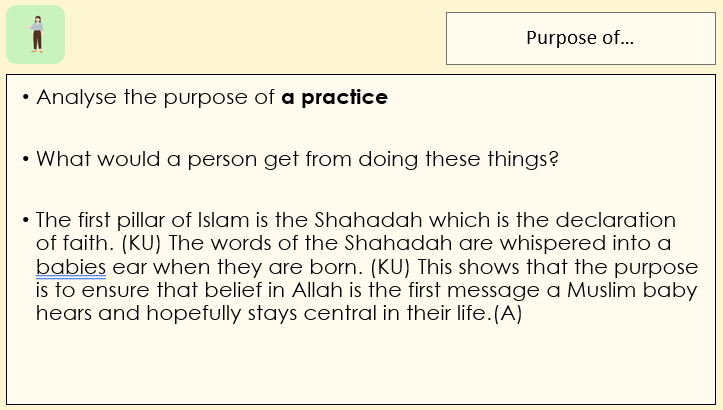
For these types of questions, I would argue that we’re back to common sense and THINKING. Take two facts about whatever the practice is and the explain how that shows the purpose.
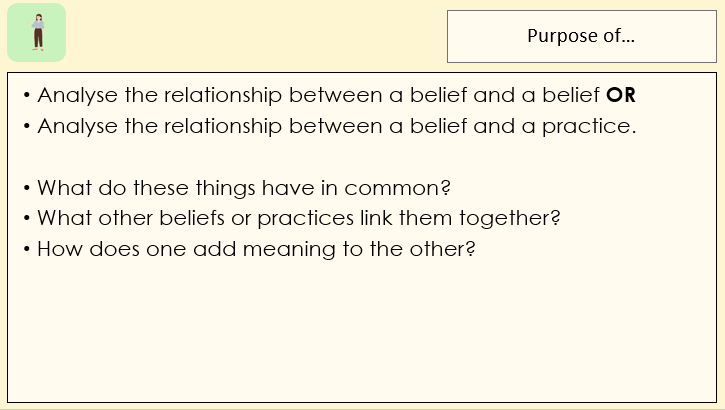
I think this type of question is MUCH more fun and it’s where the knowledge organisers come back into play. Every time I teach a new belief or practice, I’m asking pupils to think about links to what they’ve already learned. The person to find the most connections wins!
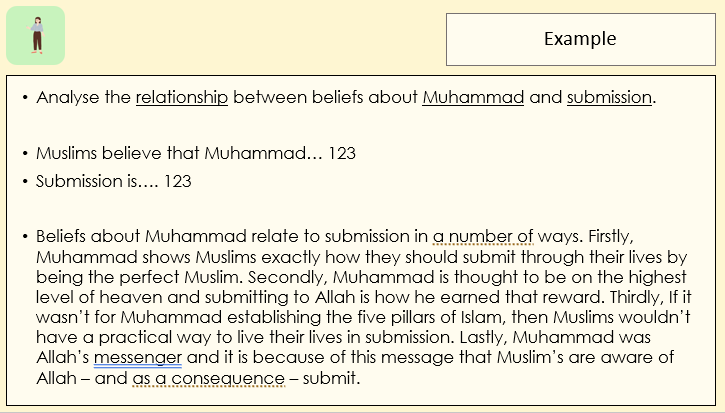
This is how I would structure a question like this – 3 facts about the first mandatory content heading, 3 facts about the second, then 4 ways those things connect to each other – or both connect to another belief/practice. I’ll post examples over the next few weeks.
Next up… my approach to teaching exam skills for the morality section. I hope you can cope with this level of excitement!!