

My approach to the Higher assignment
Choosing a question
My starting point is for pupils to choose a topic that is of interest to them. This absolutely could be something we have studied in class or perhaps at another level – and for some pupils that is definitely advised – but it can also be something that they are passionate about.
By allowing more choice, it also means that if a pupil is planning to apply for university, they could choose something that proves an interest in the subject for which they are applying. For example, one of my pupils was applying to study Business with International Relations – so they chose to focus their assignment on ethical issues arising from trading inequalities.
However – and that’s more like a HOWEVER – I also say that they should not be choosing something that is too niche. Notice that trading inequalities is still an option on the Course Spec! To put a topic to the test, they must find it in one of the books we have in the department OR on a mainstream website (like BBC bitesize or similar). This caveat stops pupils from diving down rabbit holes and ultimately becoming disadvantaged.
The other thing that I highlight to my pupils is the course report advice. Assignments that focus on World Religion tend to not do as well as Morality/RPQ and I simply share that advice. I had a pupil who focused on Christianity last year – and I thought her assignment was excellent – but she only got an A on appeal.
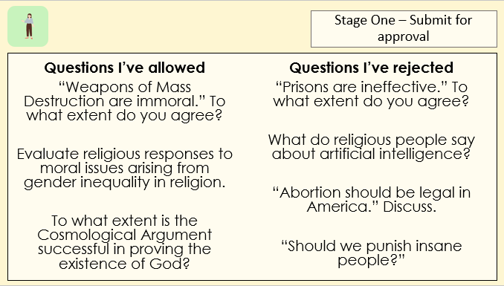
In the Higher exam, the 20-mark questions are designed for the candidates to be able to show all three skills. A question that begins ‘what’ or ‘why’ or ‘should’ narrows the scope of a question and make it very hard to evaluate whilst also answering the question they’ve set.
I also often have candidates who want to choose titles that are not RMPS but more Modern Studies or Politics. An assignment must have a religious, moral, or philosophical focus – or actually all three. Legality does not guarantee morality – nor does the effectiveness of any particular system. Choosing a topic that isn’t really within the scope of RMPS obviously limits the marks they can access. When in doubt, just choose a past exam question.
Planning
The next step is to spend some time researching and putting together a rough essay plan. We keep this really simple and provide this framework to guide them in this.
All we’re looking for at this stage is bullet points on what they are planning to include.
| Question |
| “The existence of evil proves that God does not exist.” To what extent do you agree? |
| Introduction |
| Define evil: moral evil results from human actions; natural evil includes suffering caused by disease and natural disasters. Outline Mackie’s paradox: God is omnipotent, God is wholly good, yet evil exists. Explain the problem: a good God would want to prevent evil, and an all-powerful God would seem able to do so. |
| Section One |
| Question/issue: Can the blame be placed on Humans not God? Ideas Free will defence: humans choose to cause harm. God allows freedom because genuine moral choices require the possibility of choosing wrongly. Soul-making theodicy: facing difficulties allows people to develop qualities such as courage, compassion and patience. Sources: Irenaeus, John Hick. |
| Section Two |
| Question/issue: If not humans, then can God avoid blame? Ideas Augustine: evil is a privation of good – something good has been damaged or is missing. God created a good world; evil arose through the misuse of free will. Sources: Augustine |
| Conclusion |
| Decide whether evil proves God does not exist or makes belief in a wholly good, omnipotent God harder to defend. Identify which response is strongest and explain why. |
Drafting the essay
When the assignment was first conceived, I can imagine the dream was that pupils would simply do research in advance of the write up – and then simply use the resource sheet to write what they had found. But of course, all that has happened is pupils writing reports in advance which they then try to recreate.
My advice at this stage is to follow a strict structure in order to help this memorisation, and to not aim to write more than 2000 words as an upper limit for very able pupils. All of my candidates type – which generally helps with their time management too.
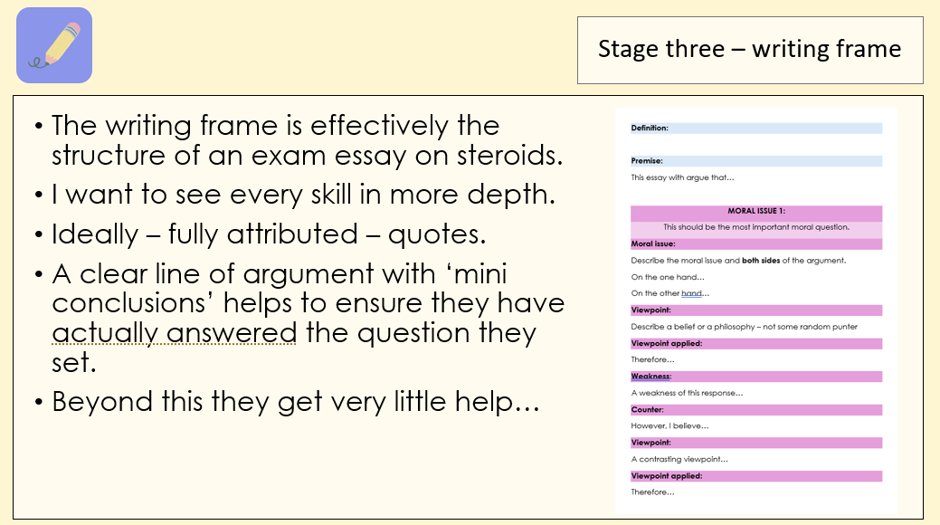
We provide this template for writing – you can download it here – but here’s a completed one from one of my pupils who went on to be given 100% on the Assignment (shared with her permission!)
| Definition |
| Selective abortion is the termination of a pregnancy because of a particular characteristic or condition of the foetus. Prenatal screening and diagnostic tests can identify some conditions before birth, including Down’s syndrome. However, knowing that a foetus has a condition does not always tell parents how severely it will affect their child. Parents may therefore face difficult decisions involving uncertain predictions about suffering, quality of life and the support their family will need. |
| Premise |
| This essay focuses on abortion following a diagnosis of disability or a serious medical condition. This raises questions about whether preventing anticipated suffering justifies abortion and whether selecting against disability undermines the equal value of human life. In this essay, I will evaluate Buddhist, utilitarian, Christian and Kantian responses to selective abortion. I will consider whether preventing severe suffering can justify abortion and whether selective abortion encourages discrimination against disabled people. |
| ISSUE ONE: |
| Is it morally justifiable to abort a child based on anticipated need or suffering? |
| Moral issue |
| One moral issue is whether predictions about future suffering provide a sufficient reason for selective abortion. Some conditions cause severe pain or greatly shorten a child’s life. However, disability does not necessarily mean that someone will have a poor quality of life. This means that we must distinguish between preventing severe suffering and assuming that a disabled life is less worth living. |
| Viewpoint |
| Buddhist ethics emphasises ‘ahimsa’, or non-harm, and the first precept is to refrain from taking life. Compassion is also central to Buddhism. Many Buddhists regard abortion as taking life and therefore as an action with negative karmic consequences. |
| Apply viewpoint to issue |
| Therefore, in Buddhism, abortion is generally seen as morally wrong as it involves taking life and creates negative karma. However, Buddhism is not absolutist, and selective abortion may be morally acceptable if the intention is compassionate and aims to reduce significant suffering. This is particularly true where continuing the pregnancy would lead to extreme suffering for the child or mother. |
| Criticise viewpoint |
| A difficulty with this response is the tension between avoiding the taking of life and responding compassionately to suffering. If a condition is expected to cause severe pain and a very short life, continuing the pregnancy may also appear harmful. This shows that the principle of non-harm does not always provide a straightforward answer when every available choice may involve suffering. |
| Counter criticism |
| However, this tension does not necessarily make Buddhist ethics inconsistent. Recognising that a decision is morally difficult is different from treating abortion as harmless. I think considering intention and circumstances is a strength because it allows compassion towards parents without dismissing the value of the foetus’s life. Nevertheless, compassion alone is insufficient: parents also need reliable information about the condition and possible care. |
| Contrasting viewpoint |
| Utilitarianism is a consequentialist approach, meaning that it judges actions by their consequences. Classical utilitarians follow the Greatest Happiness Principle: the right action is the one that produces the greatest overall balance of happiness over suffering for everyone affected. Each person’s interests should receive equal consideration. |
| Apply viewpoint to issue |
| A utilitarian may support selective abortion if it is expected to prevent more suffering than continuing the pregnancy. They would consider the likely effects on the future child, the pregnant woman and the family. However, utilitarianism does not automatically support abortion whenever disability is diagnosed. If the child could have a fulfilling life and the family could receive effective support, continuing the pregnancy may produce the better outcome. |
| Criticise viewpoint |
| A weakness is that these consequences cannot be predicted with certainty. A diagnosis may identify a condition without accurately predicting the child’s quality of life. Equating dependence on others with unhappiness also risks prejudice: needing support does not mean that someone’s life lacks value. This implies that a calculation based on negative assumptions about disability could justify abortion without good evidence that it would prevent severe suffering. |
| Counter criticism |
| However, uncertainty does not mean that consequences should be ignored. Parents still have to make a decision using the best information available. A careful utilitarian response would consider medical evidence, possible treatment, family support and the experiences of people living with the condition. I agree that foreseeable suffering matters, but I do not think financial cost or a lack of independence is sufficient on its own to justify selective abortion. |
| Mini conclusion |
| Overall, Buddhist ethics and utilitarianism both draw attention to suffering, although they assess taking life differently. I think selective abortion may be morally justified where there is strong evidence of severe suffering that treatment or care cannot adequately relieve. However, a diagnosis of disability alone does not meet this standard. The judgement should concern the likely effects of a particular condition, rather than an assumption that disabled lives are less valuable. |
| ISSUE 2 |
| Does selective abortion encourage discrimination against disabled people? |
| Moral issue |
| A further issue is whether selective abortion sends the message that disabled people are less welcome or less valuable. If disability is routinely treated as a reason to terminate a pregnancy, this may reinforce negative attitudes. However, a decision about whether to continue a particular pregnancy does not necessarily express a judgement about the worth of disabled people who are already living. |
| Viewpoint |
| A religious response can be found in Christian beliefs about the sanctity of life. Genesis 1:27 teaches that human beings are created in God’s image. This supports the belief that human life has inherent value, regardless of ability. Christian views on abortion differ, but Roman Catholic teaching holds that human life must be protected from conception and rejects direct abortion. |
| Apply viewpoint to issue |
| From a Roman Catholic perspective, selective abortion is morally wrong because it discriminates against disabled people and implies that their lives are less worth living. Christians argue that moral responsibility lies in protecting the vulnerable and providing care and support rather than eliminating lives based on disability. |
| Criticisms of viewpoint |
| A criticism of this Christian response is that it fails to engage with the real challenges faced by families raising children with severe disabilities. It also ignores fact that the emotional, financial and psychological strain is not removed through emphasising the value of life. |
| Counter criticism |
| Supporters would argue that a person’s right to life should not depend on how easy their care is or how others assess their quality of life. This is a strength because it protects vulnerable people from having their worth judged by their usefulness or independence. I find this convincing where opposition to abortion is accompanied by practical support. However, support alone cannot remove every form of suffering, so I do not think this response fully answers cases involving severe, unavoidable pain. |
| Contrasting viewpoint |
| Kantian ethics judges actions according to duty rather than their consequences. Kant argues that we should act only on principles that we could will to become universal laws. He also argues that humanity should be treated as an end in itself, never merely as a means. His emphasis on rational agency makes applying this principle to a foetus more complicated than simply claiming that Kant would oppose all abortions. |
| Apply viewpoint to issue |
| Kantian ethicists may respond by saying that it is morally wrong as it treats potential human life as a problem to be eliminated rather than as something with value. They also focus on the intentions behind actions and their moral duties; therefore, they would disagree with selective abortion as it implies that discrimination against people with disabilities can be justified. |
| Criticisms |
| A weakness of this response is that it can be firm, and it doesn’t sufficiently consider suffering or context. This can make it difficult to apply in real-life situations where all available options involve harm. |
| Counter criticism |
| However, supporters of Kantian ethics would respond by arguing that moral rules exist to protect human dignity, especially in difficult cases. They may say that if we allow abortions in cases of disabilities, we allow discrimination to become easier to justify. From this point of view, refusing selective abortion only reinforces humans’ moral commitment to uphold equality and prevent society from judging others worth based on ability or lack of independence. |
| Mini conclusion |
| Selective abortion raises serious concerns about discrimination, especially when disability is treated as automatically making life less worth living. However, it does not follow that every selective abortion is motivated by prejudice. I think the strongest distinction is between rejecting a life because it is disabled and responding to strong evidence of severe suffering. Society also has a responsibility to provide support so that parents’ decisions are not driven by avoidable hardship or negative stereotypes. |
| Conclusion |
| Overall, religious and non-religious responses show that selective abortion cannot be judged through a single moral principle. While concerns about sanctity of life, discrimination and ableism are compelling and demand serious consideration, they do not fully account for situations involving unavoidable and extreme suffering. I therefore conclude that selective abortion may be morally justifiable in limited circumstances where the intention is compassionate, and the suffering anticipated is severe and inescapable. However, such decisions must remain exceptional, carefully considered, and never based on assumptions that devalue disabled lives, as failing to maintain this balance risks serious moral and social consequences. |
Write Up
Not much to say on this – other than every one of my pupils types, they use 1.5 spacing, and a font like Century Gothic or Gills Sans. We print double sided as both sides are scanned by the QS regardless.
Use the resource sheet – look at the examples on Understanding Standards – and use it to full effect. Some pupils seem to think they need all of the web addresses or books they’ve used on the resource sheet – so it’s more like a bibliography. This is not the case. Use it as a prompt sheet for writing.
Reasonable Assistance
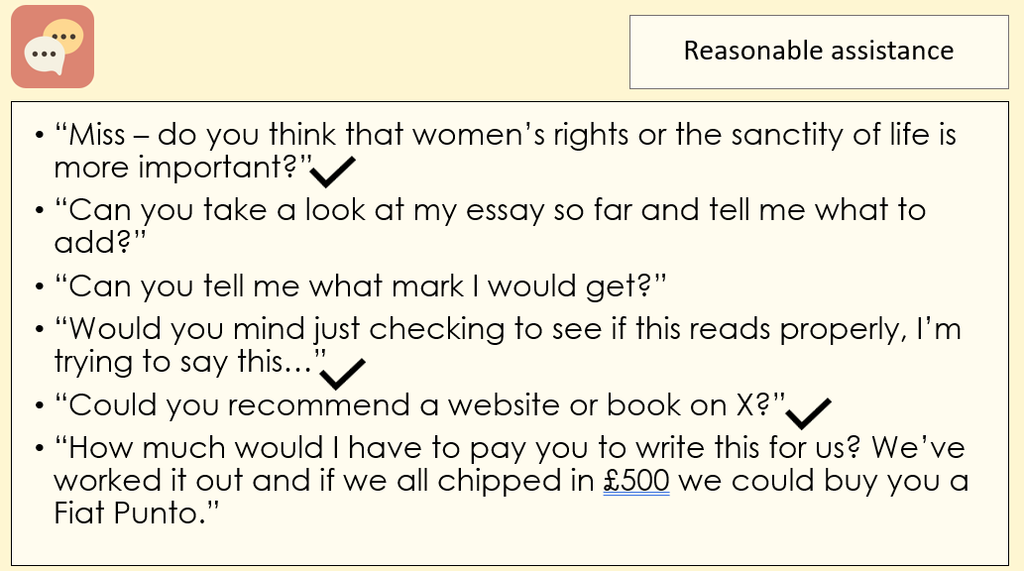
In my STARME talk, I also took the chance to share my thoughts on ‘reasonable assistance’. The process outlined above is one I expect my pupils to do independently. I think the slide summarises my overall thoughts well!
Questions? Just get in touch! And no, this is not my approach for National 5 – I’ll share that in another post!